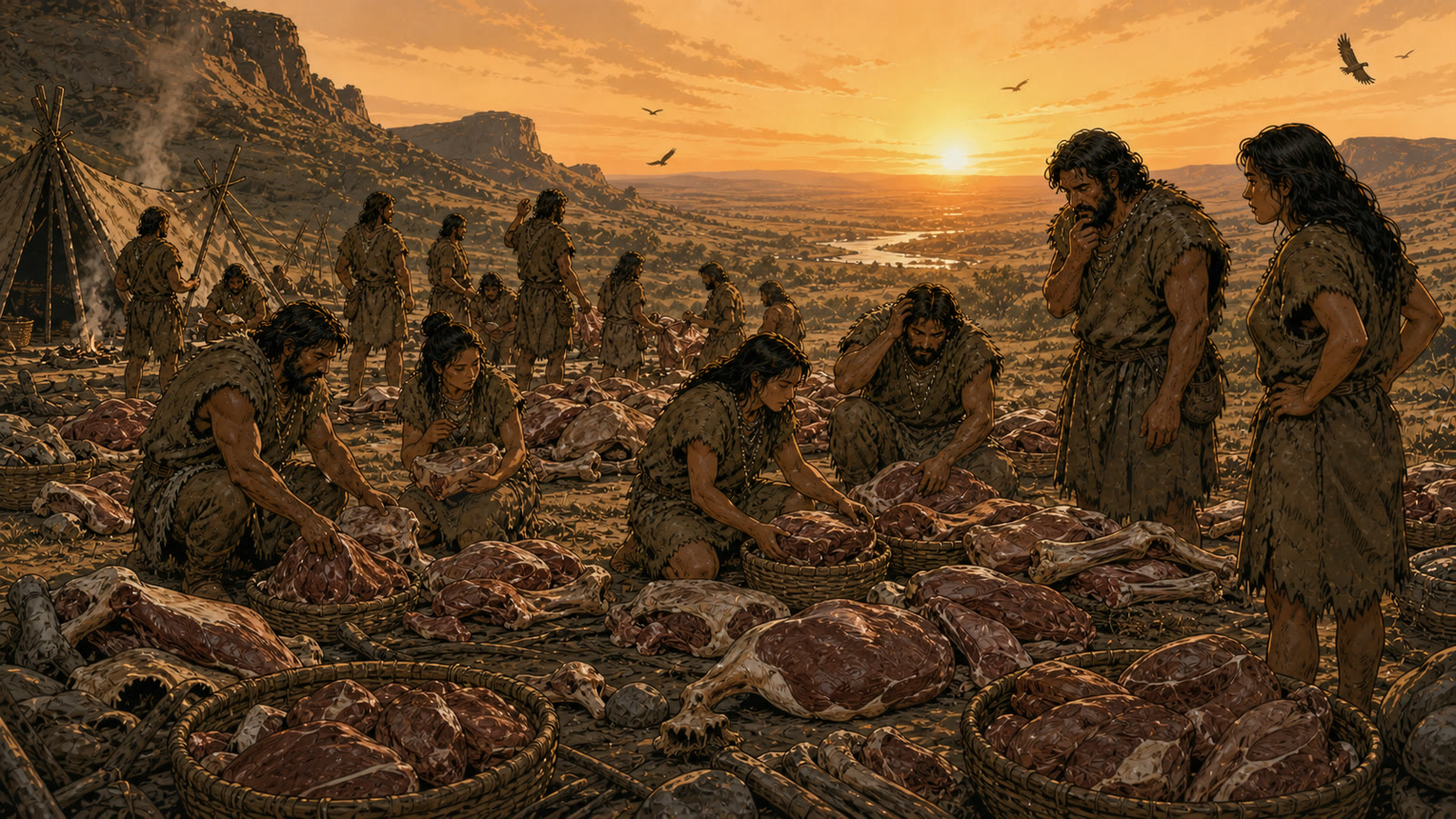
 Illustrative reconstruction
How Ancient Humans Saved Meat Without a Fridge
A hunt created a deadline. People stacked drying, salt, smoke, cold, and control until spoilage finally lost.
Short answer
They did not rely on one miracle trick. They made meat harder for microbes to use by removing water, adding salt and smoke, borrowing cold from the landscape, and carefully controlling fermentation.
Each defense had a weakness. The breakthrough was stacking imperfect defenses so that failure in one layer did not ruin the food.
The invisible deadline
The animal was down. That should have been the victory. Instead, a second hunt began: save more meat than the group could eat before heat, moisture, and invisible life took it back.
At Kharaneh IV in eastern Jordan, archaeologists found 10,839 bone fragments, almost nine in ten of the identified remains from gazelle. Hearths and postholes nearby point to organized processing, not just one meal.
Drying: the first barrier
Thin slices expose more surface to dry air and gentle heat. The outside tightens and darkens as water leaves. But thick cuts and fatty pieces can still spoil inside, which is why drying alone was never a universal answer.
Salt: stealing water from the enemy
Salt pulls water outward and makes what remains harder for microbes to use. Evidence from central Sudan shows deliberate fish salting more than 8,000 years ago — older than the pyramids and the wheel.
Cut patterns and preservation evidence from central Sudan support deliberate fish salting more than eight millennia ago.
Smoke and cold: adding more defenses
Warm smoke helps pull moisture from meat and leaves compounds that slow some spoilage organisms. In cold regions, people turned frozen earth into storage: the landscape itself became part of the recipe.
Controlled change — not random rot
Fermentation works only when food, temperature, airflow, container, and time stay within a safe pattern. A 2001 Alaska botulism outbreak showed how changing a traditional setup to a warmer, more closed container could remove invisible protections.
Fourteen people were affected in the 2001 Alaska outbreak; several developed neurological symptoms and two required ventilation. The case shows why cold and airflow were not optional details.
Why one trick was never enough
Modern food science calls this hurdle technology. Drying, salt, smoke, cold, and controlled processing each block a different route spoilage can use. One hurdle may fail. Several together create a much harder problem for the invisible hunter.
One weak barrier can fail.
Five make spoilage fight for every route.
- Jerky uses drying.
- Bacon combines salt and smoke.
- Refrigeration uses cold.
- Controlled fermented foods depend on several conditions working together.
The machines changed. The strategy did not. Long before anyone could see a microbe, people learned to stack the details that worked — and remember the failures.
Sources & evidence notes
- Kharaneh IV archaeological evidence, eastern Jordan (about 19,000 years ago).Supports: Gazelle-dominant bone assemblage, hearths, postholes, and intensive processing context.
- Central Sudan salted-fish evidence, Journal of Archaeological Science (2018), doi:10.1016/j.jas.2018.02.008.Supports: Deliberate fish salting more than 8,000 years ago.
- CDC MMWR — Alaska botulism outbreak associated with fermented beaver, 2001.Supports: Consequences of changing temperature, airflow, and container conditions.
- FDA food-preservation guidance on water activity.Supports: Why reducing available water slows microbial growth.
What remains uncertain
- The Kharaneh IV evidence supports intensive gazelle processing, but the exact preservation workflow cannot be reconstructed step by step from bone alone.
- Preservation methods varied sharply by climate, available salt, fuel, season, and local tradition.
If humans solved this… how did they solve that?


New episodes, one “how it worked” takeaway at a time.
A short note when a new story lands: the question, the mechanism, one thing worth knowing. No filler.
See our privacy basics. Unsubscribe anytime once live.