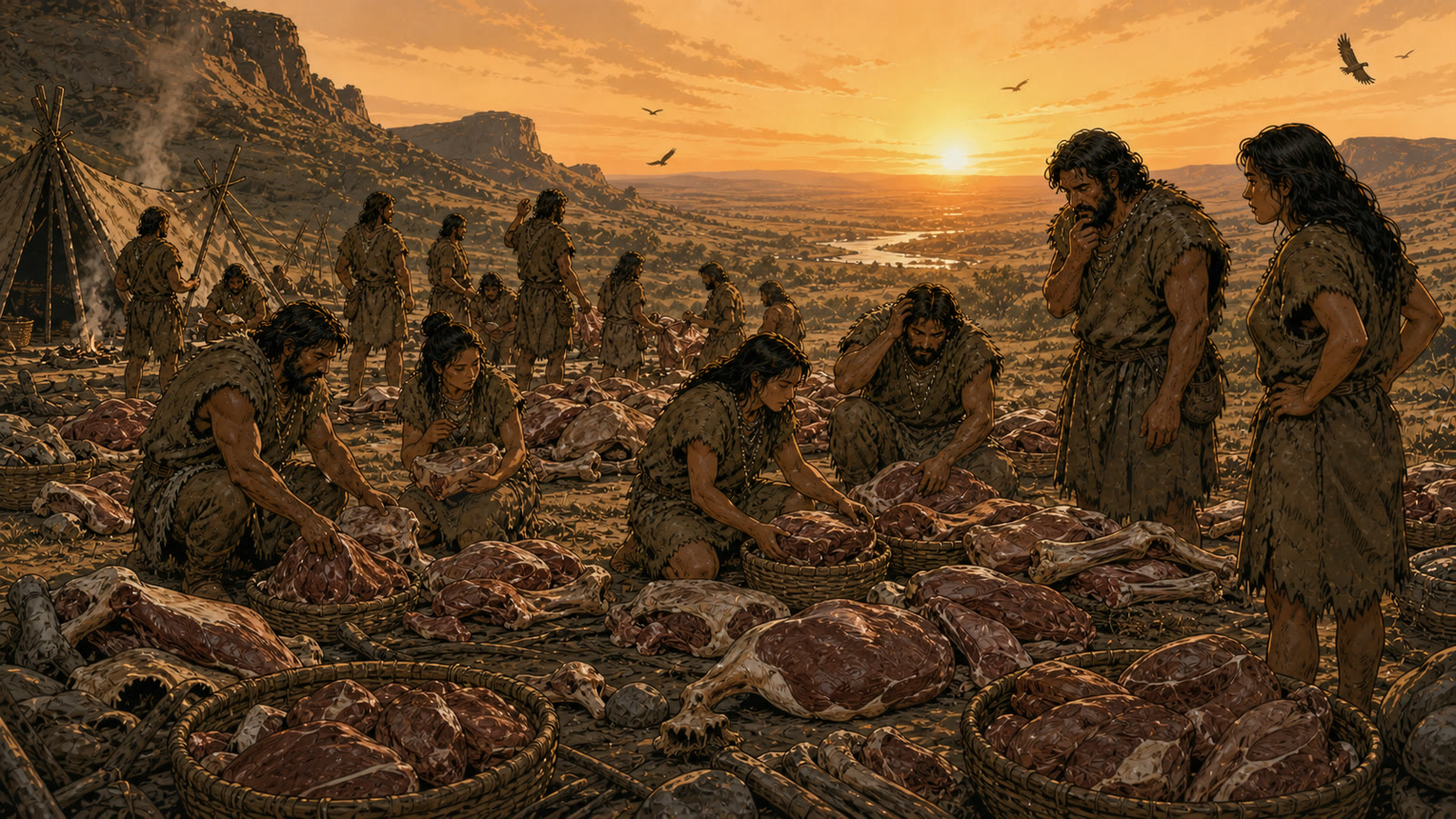
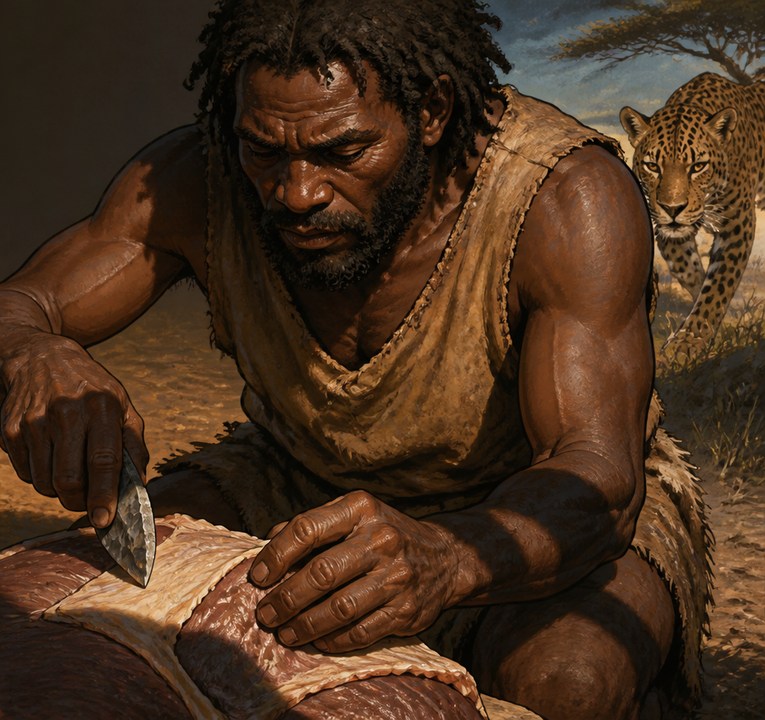
 Illustrative reconstruction
How did people boil water before pots?
Drop fire-heated stones into anything waterproof, repeat. Archaeologists still trip over the leftovers.
Short answer
They boiled in containers that couldn't touch flame — hide bags, baskets, wooden vessels, even pits lined with hide — by transferring heat in batches: stones heated in a fire, dipped into water until it boiled, reheated, repeated. The leftovers of that cycle, fields of cracked 'fire-cracked rock', are among the most common archaeological sites on Earth.
Ceramics arrived astonishingly late — the earliest known pottery is around 20,000 years old — yet boiling is far older. Heat-transfer engineering filled the gap.
Episode video
The episode video embeds here when it goes public. We don’t link guesses.
The human problem
Boiling is quietly miraculous: it unlocks calories locked inside roots and seeds, melts fat out of bones, kills waterborne nasties, softens tough material, and neutralizes some toxins — all with one trick. But a flame needs a container that sits in fire, and watertight materials burn: skin, bark, wood, fiber.
And pottery? Surprisingly late. For most of the human story there was no pot to boil in. So how do you boil without a pot?
How humans solved it
Stone boiling: build a fire beside (not under) a waterproof vessel — a hide-lined pit, a basket, a wooden box, a stomach bag. Heat dense stones in the flames until they soak up heat, then lower them into the liquid. Each stone delivers a burst of heat; pull them out before they cool completely, reheat, repeat. Within a couple of cycles, it boils.
The same logic powered earth ovens: pits lined with heated stones and green vegetation, food tucked in, everything sealed to steam slowly for hours. Between stone-boiling and pit-steam, cooks got wet heat — the deep technology behind rendered grease, cooked flour, and safe broth — with zero ceramics.
Why it worked
- Dense stones store serious heat and release it fast on contact with water — batch-mode heat transfer instead of a continuous burner.
- Keeping flame away from the container sidesteps the flammability problem entirely.
- Rock choice is knowledge: homogeneous stones survive repeated heating; layered or wet stones can crack explosively. Cooks learned their geology the hard way.
Fire-cracked rock scatters, boiling pits, and burnt mounds — heaps of heat-shattered stones with troughs — blanket landscapes on several continents, marking where hot-stone cooking ran for generations.
The earliest known pottery vessels date to roughly 20,000 years ago. Hot-stone cookery sites and the deep antiquity of earth ovens imply wet-cooking techniques long predate ceramic pots — the inference being that non-ceramic boiling was the norm, not a stopgap.
Ethnographic accounts document stone boiling in hide vessels on the North American plains, in wooden boxes in the Pacific Northwest, and in Australian shallow vessels — the same cycle of heated stones, waterproof container, patience.
Sources & evidence notes
- Thoms, A.V. (2009) American Antiquity — 'Rocks of Ages': propagation of hot-rock cookery in western North America.Supports: Scale, distribution, and archaeology of hot-stone cookery features.
- Liu, L. et al. (2012) Science — earliest known pottery vessels (~20 ka), Xianrendong Cave, China.Supports: The surprisingly late date of ceramic containers relative to cooking needs.
- British and Irish burnt-mound archaeology (heat-cracked stone mounds with associated troughs).Supports: Monumental scale of accumulated stone-boiling debris in some regions.
What remains uncertain
- When deliberate boiling first happened. Hide, wood, and baskets don't preserve; the earliest physical boiling setup will never be found, only inferred.
- How much stone boiling was cooking versus processing (grease rendering, oil extraction, brewing) — the rock record doesn't label its recipes.
If humans solved this… how did they solve that?
New episodes, one “how it worked” takeaway at a time.
A short note when a new story lands: the question, the mechanism, one thing worth knowing. No filler.
See our privacy basics. Unsubscribe anytime once live.