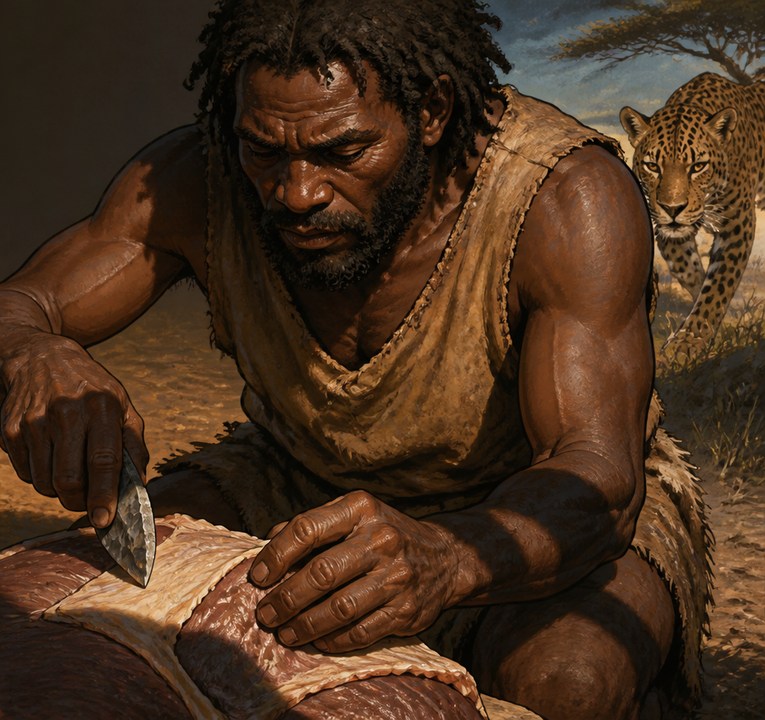
 Illustrative reconstruction
How did people make fire before matches?
For most of human history, making fire was the backup plan. Keeping it was the job.
Short answer
Mostly, people didn't make fire from scratch — they kept it alive, carried it, and banked it like a resource worth guarding. When a fresh fire was unavoidable, they knocked hot sparks from iron pyrite onto prepared tinder, or ground out an ember with friction, then blew that ember into flame.
The hard part was never the flame. It was the ember.
Episode video
The episode video embeds here when it goes public. We don’t link guesses.
The human problem
Fire is not a thing you own. It is a chemical process that dies the moment you stop feeding it — overnight, in the rain, while you sleep. Your phone loses charge and you grumble; lose your fire and the night gets cold, the food stays raw, and the predators get confident.
So the first great fire technology probably wasn't ignition at all. It was logistics: keeping one process running continuously, and moving it from place to place without letting it go out.
How humans solved it
Archaeologists find clustered ash, burned bone, and fire-altered sediment in discrete patches — hearths — inside cave sites hundreds of thousands of years old. Repeated, organized fire spots imply maintenance: fuel collected, fire tended, locations reused.
In many recorded cultures, travelers carried smoldering embers in damp containers or rotten wood rather than relighting from zero at every stop. Making fire was the backup; transport was the norm.
When a genuinely new fire was needed, two main toolkits existed. The percussion method strikes flint against iron pyrite (or marcasite): tiny particles of iron sulfide shave off, heat up as they oxidize in air, and land glowing on prepared tinder — usually processed tinder fungus, whose fuzzy surface catches a spark as a slow, flameless ember. That ember then goes into a fine bundle and gets coaxed to flame with controlled breath.
The friction family works differently: a drill or saw grinding dry wood produces a pinch of hot powder that glows as an ember, which meets the same tender care — tinder nest, steady airflow, flame. And in Southeast Asia, craftsmen later compressed air so hard in a sealed wooden piston that the heat of compression itself ignited tinder. No sparks required.
Why it worked
- Pyrite sparks are literally tiny burning metal shavings — hot enough, and numerous enough, to light material engineered to glow without bursting into flame.
- Tinder fungus behaves like a match head in slow motion: huge internal surface area, smolders for minutes instead of flashing for a second, giving you time to transfer it.
- An ember is forgiving to carry but demanding to grow — hence blowpipes, bundles, and technique passed person to person.
The Copper Age man found frozen in the Alps carried knife, retoucher, and prepared tinder fungus strung on his gear — an everyday personal kit consistent with exactly this spark-and-tender system.
Paired flints and pyrite nodules found together in later Stone Age graves are widely interpreted as strike-a-light sets: the combination makes little practical sense as tools, and residues fit the interpretation.
Sources & evidence notes
- Berna, F. et al. (2012) PNAS — microstratigraphic evidence of in situ fire in Acheulean strata, Wonderwerk Cave, South Africa (~1.0 Ma).Supports: Very early repeated, contained fire use (hearth-like features).
- Goren-Inbar, N. et al. (2004) Science — evidence of hominin control of fire at Gesher Benot Ya'aqov, Israel (~790 ka).Supports: Repeated spatially organized fire use in open-air settings.
- Equipment inventory of the Iceman, South Tyrol Museum of Archaeology (Bolzano).Supports: Composition of a real Copper Age personal fire kit (tinder fungus, flint tools).
- European Mesolithic–Neolithic strike-a-light finds literature (flint + pyrite pairings, use-wear and residue studies).Supports: Percussion fire-lighting as an established, portable technology.
What remains uncertain
- Exactly when routine fire-making began. The evidence proves regular use very early; proving manufacture is far harder than proving maintenance.
- Whether some early hominin groups made fire at all, versus primarily keeping natural fire alive once obtained.
If humans solved this… how did they solve that?
New episodes, one “how it worked” takeaway at a time.
A short note when a new story lands: the question, the mechanism, one thing worth knowing. No filler.
See our privacy basics. Unsubscribe anytime once live.