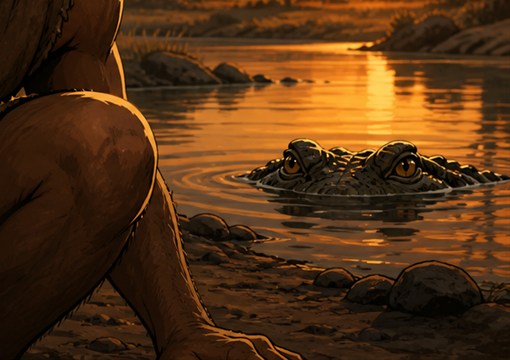
 Illustrative reconstruction
How did humans sleep before beds?
On plants — chosen, layered over ash, and set on fire periodically. Pest control included.
Short answer
On deliberately built plant bedding: sedge and grass laid thick enough to insulate the body off the cold ground, often topped with insect-repelling leaves, and underlaid with a compacted layer of ash that crawling insects hate. The oldest known example is around 200,000 years old.
It wasn't a pile of leaves. It was plant selection plus pest management plus scheduled renewal — a mattress system.
Episode video
The episode video embeds here when it goes public. We don’t link guesses.
The human problem
Night is when humans are slowest, blindest, and coldest. The ground pulls heat out of a sleeping body relentlessly; biting insects and their parasites treat a warm sleeper as an all-you-can-eat buffet; and bad sleep means worse decisions tomorrow.
So 'where do we sleep?' was never a comfort question. It was a survival question with three parts: insulation, pests, and hygiene.
How humans solved it
At Border Cave, South Africa, excavators found fossilized sedge-and-grass bedding preserved where people slept, with compacted ash layers beneath it and remains of insect-repelling bush leaves mixed in. People were building layered mattresses roughly 200 millennia ago.
At Sibudu Cave, South Africa, Middle Stone Age bedding layers included riverine leaves known for their insecticidal chemistry, laid beneath and around sleeping surfaces.
The maintenance cycle matters as much as the build. Old bedding was periodically burned in place — clearing parasites and refreshing the site — and fresh plant matter laid down over the compacted base. Ash from those burns became the next layer's pest-proofing. Sleep surfaces weren't furniture; they were managed habitat.
Why it worked
- Thick dry vegetation traps air: a cheap, renewable insulator that lifts the sleeper off heat-stealing ground.
- Ash is miserable for crawling insects — it abrades and desiccates them — so a compacted ash subfloor doubles as a barrier.
- Aromatic leaves add chemical deterrence against flying biters; burning old bedding resets the whole system hygienically.
Studies of present-day hunter-gatherers show sleep shaped by fire, group watchfulness, and segmented waking — a reminder that 'eight hours on a mattress' is one modern answer, not the species default. Analogy informs; it does not prove what ancient people felt.
Sources & evidence notes
- Wadley, L. et al. (2020) Science — grass bedding, ash layers, and site maintenance at Border Cave, South Africa (~200 ka).Supports: Construction, composition, and renewal cycle of the oldest known bedding.
- Wadley, L. et al. (2011) Science — Middle Stone Age bedding construction and settlement patterns at Sibudu, South Africa (~77 ka).Supports: Plant selection including insect-repelling leaves in bedding build-up.
What remains uncertain
- How universal built bedding was — organic beds survive only in exceptional conditions, so absence elsewhere may be preservation bias.
- How much bedding design was about comfort versus pest control versus social space; the layers serve all three and can't fully be separated.
If humans solved this… how did they solve that?


New episodes, one “how it worked” takeaway at a time.
A short note when a new story lands: the question, the mechanism, one thing worth knowing. No filler.
See our privacy basics. Unsubscribe anytime once live.