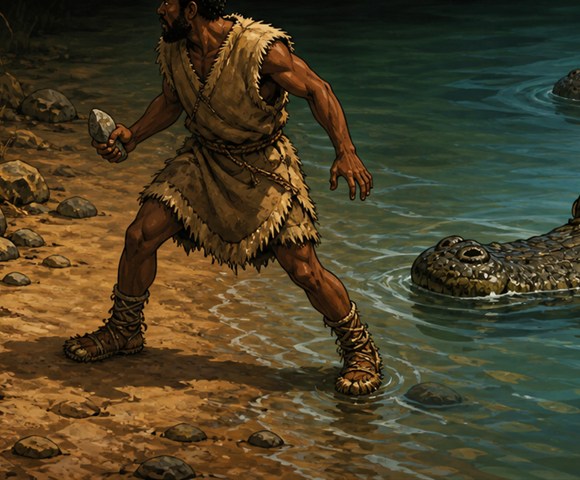
 Illustrative reconstruction
How did humans carry heavy things before wheels?
With a strap across the head and the skeleton doing the holding — everywhere wheels couldn't go.
Short answer
With body geometry, not gadgets: tumplines and head straps that hang a load from the head and neck so the spine carries it, plus frame backpacks that shift weight onto the hips. In biomechanics tests, trained head-load carriers have walked with loads of a fifth of their body weight at almost no extra energy cost.
Wherever heavy things met rough ground, the answer was the same idea: let bone, not muscle, hold the weight.
Episode video
The episode video embeds here when it goes public. We don’t link guesses.
The human problem
Everything a moving band owned had to travel on human bodies: food, water, tools, shelter parts, children. Arms are terrible cranes — they tire quickly and they're needed for literally everything else. And wheels, whenever they finally arrived locally, were useless in forest, swamp, snow, hillside, and mud.
The engineering brief: move heavy loads, keep hands free, don't wreck the workers. Solved without metal, without engines, using a strap and posture.
How humans solved it
The tumpline is a wide strap passing over the crown of the head (or brow), attached to a load carried on the back. Leaning forward slightly puts the line of weight through the neck and spine — structures evolved to hold a head all day — while the shoulders guide and the legs push. Variants appear independently across the Americas, Africa, and Asia, wherever porters met long distances.
Physiologists measured East African women accustomed to head-loading walking with loads around 20% of their own body weight at essentially no increase in energy cost — a result so strange it forced researchers to rethink assumptions about human load carriage.
The Copper Age man from the Alps carried a U-shaped hazel frame with a hide bag — a rigid external backpack that moves weight onto the hips, recognizable as a design today. Wood and fiber rarely survive; this one froze.
Why it worked
- Aligning load with the spine converts carrying from muscle-lifting to bone-stacking; muscles only balance and steer.
- Frames and straps shift weight to hips and trunk — the strongest load path the body owns — leaving hands free for tools, terrain, and children.
- Skill compounds: practiced carriers develop gait rhythms that recycle energy step to step, which is why measured costs defy naive expectations.
Sources & evidence notes
- Maloiy, G.M.O. et al. (1986) Nature — energetic cost of carrying loads by African women.Supports: Measured near-zero extra energy cost of skilled head loading (~20% body weight).
- Equipment inventory of the Iceman, South Tyrol Museum of Archaeology (Bolzano) — hazel backpack frame and hide bag.Supports: Physical existence of Copper Age framed load carriage.
What remains uncertain
- How old tumplines are. Straps are fiber and hide; both rot. Depictions and ethnography prove recent ubiquity, not deep antiquity.
- Which came first where: head-loading, shoulder yokes, and frame packs likely rose independently; mapping origins precisely isn't currently possible.
If humans solved this… how did they solve that?
New episodes, one “how it worked” takeaway at a time.
A short note when a new story lands: the question, the mechanism, one thing worth knowing. No filler.
See our privacy basics. Unsubscribe anytime once live.